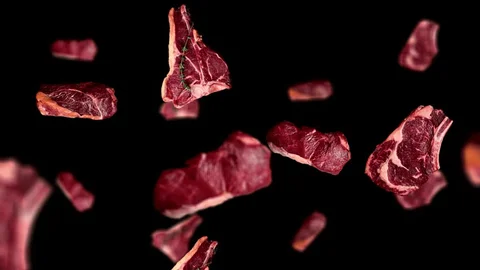
Red Meat on the Environment
Production Assignment
2026
Do you like red meat?
If you do...
Do you know what suffers because of it?
Red meat is sourced in grasslands. Grasslands’ climates have cold winters and warm summers, the vegetation includes grass and forbs. Some wildlife includes giraffes, bison, and ostriches. Geographical features are open areas of land with few trees and dominated with grass
However!
Grasslands' native plants, trees and shrubs have stopped revitalising because they have been altered because of grown grasses for livestock feed and fertilised legumes. The unnatural growing has destroyed the habitats of wildlife.
Production Concerns:
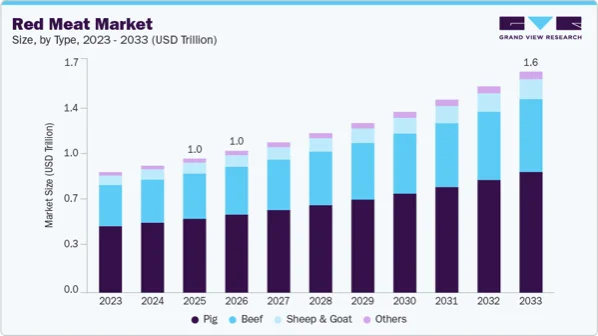
By 2020 it was found that 340 tonnes of red meat was consumed and produced annually, and consumption is presumed to increase by 2050.
Cattle is first born on the farms, then they are fed to establish muscle and marbling. Then the animal grows until deemed marketable. The animal is then slaughtered and processed. After processing the animal goes through the chilling/aging process for inspection and to make the meat more tender. The final step is for the cuts.
Economical Benefits:
The red meat industry provides numerous employment opportunities to raise animals and the industry results in massive revenue to the countries that are the biggest exporters of red meat.
The red meat industry continues because it earns more money and it provides income for those working in the industry and the economy.
Export sales of red meat and livestock in 2018-19 totalled $28.5 billion (State of the Industry Report 2020).
The Doom and Gloom
Deforestation is one of the biggest environmental impact caused by the red meat industry, most specifically beef. Agriculture globally contributes to the loss of forests by 41%. The amazon rainforest has suffered massive loss from the beef industry. The rainforest contributed 20% of the worlds oxygen due to it’s dense forest. The Amazon covered 3.4 million square miles over South America, but has since lost around 20% of it’s original forest. Deforestation has severe consequences of global warming as less carbon dioxide is being stored within the earth.
Not Sustainable :((
Experts predict meat consumption will rise 15% by 2031 due to the growing population. (OECD, 2022). It is also predicted several environmental consequences will occur such as global warming rising because of continued deforestation and increased water consumption because of feeds and irrigation over 5 years. The same global consequences except more severe, water scarcity will occur and natural species will go extinct, along with intense heatwaves within the next 50 years.
Is There Another Way?
Lab grown meat also called cultured meat is a new technological advancement to reduce the environmental impact and the suffering of animals (J Bioeth Inq. 2024). Production of lab grown meat takes up less land by 99% and uses 96% less water compared to traditional animal grazing. Lab grown meat will lower carbon emissions significantly if farmed with renewable energy compared to their conventional counterpart which contributes 80% to deforestation.
Pros and Cons: public opinion
- Scientists recommend cultured meat to reduce the environmental impact and the suffering of animals. Production of lab grown meat takes up less land by 99% and uses 96% less water compared to traditional animal grazing.
- Cultured meat may cause more environmental impacts than traditional methods due to the machines used.
- Some people do not want to eat synthetic meat and are strongly against regulating lab grown meat.
What You Can Do
You don't need to become vegan – It's an option, sure!
But, what you can do is...
- Shop for less meat each week
- Choose smaller meats
- Shop at local butchers and markets
Remember, the future is sustainable, only if you contribute to it!
Bibliography
La chaire bien-être animal (10 October 2024) Grasslands help offset part of cows’ greenhouse gas emissions, TRUE or FALSE?, La chaire bien-être animal, accessed 21 August 2026.
SoilforLife (n.d.) Intensive farming is eating up the Australian continent – but there’s another way, SoilforLife, accessed 21 August 2026.
Yahav M (10 November 2021) MEAT CONSUMPTION, Redefine Meat, accessed 21 August 2026.
Our World in Data (August 2017) Meat and Dairy Production, Our World in Data, accessed 21 August 2026.
The economic significance of Australia’s red meat and livestock industry (10 September 2020), Mla, accessed 21 August 2026.
Amazonteam (n.d.) Why It Matters: Amazon Conservation, The amazon conservation team, accessed 21 August 2026.
Eurogroupforanimals (22 April 2021) Beef production drives deforestation five times more than any other sector, Euro group for animals, accessed 21 August 2026.
Peterson J (22 February 2024) How Animal Agriculture Is Accelerating Global Deforestation, Earth.Org, accessed 21 August 2026.
Climatecouncil (2 April 2026) Deforestation and Climate Change, Climate council, accessed 21 August 2026.
OECD (29 June 2022) OECD‑FAO Agricultural Outlook 2022‑2031, OECD, accessed 21 August 2026.
Biologicaldiversity (29 June 2022) Appetite for Change: A Policy Guide to Reducing Greenhouse Gas Emissions of U.S. Diets by 2030, Center for biological diversity, accessed 21 August 2026.
Meat's Environmental Impact (21 November 2025), Stanford University, accessed 21 August 2026.
Apo (10 July 2023) Red and processed meat in the context of health and the environment: many shades of red and green, Australian Policy Online, accessed 21 August 2026.
Visionofhumanity (6 April 2021) Our sustainable future: Lab-grown meat, Vision of humanity, accessed 21 August 2026.
The Counter (22 September 2022) Lab-grown meat is supposed to be inevitable. The science tells a different story, The Counter, accessed 21 August 2026.
Bioeth J (1 September 2023) Flesh Without Blood: The Public Health Benefits of Lab‐Grown Meat, National Library of Medicine, accessed 21 August 2026.